 DSM Partition Tool(영문).hwp DSM Partition Tool(영문).hwp |
 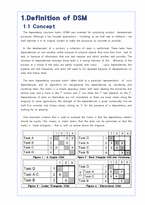 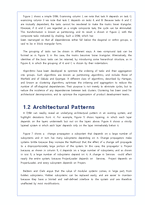   |
목차 1.Definition of DSM 2. THE ALGORITHM 3. Class Diagram 4. Program Design 5. Program Test 6. Program screen shots 본문 1.Definition of DSM 1.1 Concept The dependency structure matrix (DSM) was invented for optimizing product development processes. Although it has broader applications including, as we shall see, to software we shall describe it in its original context to make the discussion as concrete as possible. In the development of a product, a collection of tasks is performed. These tasks have dependencies on one another, either because of physical objects that must flow from task to task, or because of information that one task requires and which another task provides. The structure of dependencies amongst these tasks is a strong indicator of the efficiency of the process as a whole. If the tasks are tightly coupled, with many cyclic dependencies, the pipeline will stall frequently, and tasks will need to be repeated because of dependencies on tasks that follow them. The term 'dependency structure matrix' refers both to a particular representation of such dependencies, and to algorithms for reorganizing the dependencies by reordering and clustering tasks. The matrix is a simple adjacency matrix with tasks labeling the horizontal and vertical axes, and a mark in the ith column and jth row when the ith task depends on the jth. Dependencies of tasks on themselves are not considered, so there are never marks along the diagonal. In some applications, the strength of the dependencies is given numerically, but we shall first consider only binary values, writing an 'X' for the presence of a dependency, and nothing for its absence. 참고문헌 1 Steven D. Eppinger, "Innovation at the Speed of Information", Harvard Business Review, January 2001. 2 Baldwin, C.Y. and Clark K.B., The Power of Modularity Volume 1, MIT Press, Cambridge, MA, 2000. 3 Murphy, G.C., Notkin D., and Sullivan, K.J., "Software Reflexion Models: Bridging the Gap between Design and Implementation", Vol.27, No. 4, April 2001 4 Tran, J.B., Godfrey M.W., Lee E.H.S., Holt, R.C., "Architectural Repair of Open Source Software", Proc. of 2000 Intl. Workshop on Program Comprehension (IWPC-00), 5 Parnas, D.L., "Designing Software for Ease of Extension and Contraction",Transaction on Software Engineering, SE-5(2), 1979 6 Jackson, D., "Module Dependences in Software Design", Post-workshop Proceedings of the 2002 Monterey Workshop: Springer Verlag, 2003. 7 Sullivan K., Cai Y., Hallen B., Griswold W., "The Structure and Value of Modularity in Software Design", Proceedings of the 8th European Software Engineering Conference held jointly with 9th ACM SIGSOFT International Symposium on Foundations of Software Engineering, 2001 8 Kruchten, P., "The 4+1 View Model of Architecture", IEEE Software 12(6): 42-50, 1995 9 Gebala, David A. and Eppinger, Steven D., Methods for Analyzing Design Procedures , Proceedings of the ASME Third International Conference on Design Theory and Methodology, pp. 227-233, 1991. 10 Warfield, John N., Binary Matrices in System Modeling IEEE Transactions on Systems, Man, and Cybernetics, vol. 3, pp. 441-449, 1973. 11 Hartigan, John A., Clustering Algorithms, John Wiley & Sons, New York, 1975 12 The Haystack Project. MIT Computer Science and Artificial Intelligence Laboratory. 13 Browning, T. "Applying the Design Structure Matrix to System Decomposition and Integration problems: A Review and New Directions". IEEE Transactions on Engineering management, Vol. 48, No. 3, August 2001. 14 Pimmler, Thomas U. and Eppinger, Steven D., Integration Analysis of Product Decompositions , Proceedings of the ASME Sixth International Conference on Design Theory and Methodology, Minneapolis, MN, Sept., 1994. 15 Fernandez, CIG, "Integration Analysis of Product Architecture to Support Effective Team Co-location", Master's Thesis (ME), MIT 1998. 16 Yassine, Ali, An Introduction to Modeling and Analyzing Complex Product Development Processes Using the Design Structure Matrix (DSM) Method , Quaderni di Management (Italian Management Review), www.quaderni-di-management.it, No.9, 2004. 키워드 DSM, Partition, Tool, 영문 |
2017년 6월 5일 월요일
DSM Partition Tool(영문)
DSM Partition Tool(영문)

피드 구독하기:
댓글 (Atom)
댓글 없음:
댓글 쓰기